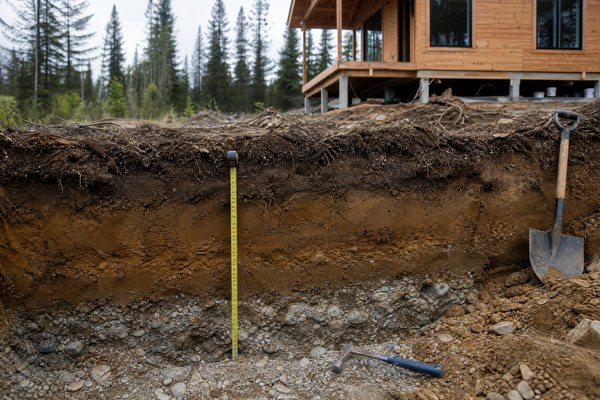
When embarking on a residential or recreational cabin development project, site selection and architectural aesthetics frequently command the majority of preliminary planning efforts. However, the ultimate longevity, structural stability, and economic viability of any building depend fundamentally upon the unseen interface between the substructure and the underlying earth. Soil type dictates the manner in which structural loads are absorbed, distributed, and sustained over decades of environmental exposure. Without a comprehensive understanding of subsurface geotechnical characteristics, developers risk severe structural displacement, differential settlement, and premature building degradation.
“The foundation of a structure is only as reliable as the geotechnical strata upon which it rests; failing to characterize subsurface soil mechanics prior to engineering design introduces catastrophic long-term risks.”
Soil is neither a static nor a homogenous engineering material; rather, it is a complex, dynamic matrix composed of mineral particles, organic matter, water, and gas voids. Variations in grain size, plasticity, moisture retention, and mineralogical composition directly govern parameters such as bearing capacity, shear strength, and volumetric compressibility. Whether evaluating a dense glacial till, a loose alluvial sand, or a highly plastic expansive clay, structural engineers must tailor foundation typologies to counteract specific geohazards. This article explores the intricate mechanical relationship between soil types and cabin foundations, offering developers, architects, and site planners an authoritative reference for mitigating subsurface risks across diverse geographical terrains.
Direct Answer: How Soil Type Shapes Foundation Design
At its core, soil type dictates foundation design by establishing the maximum allowable bearing pressure, moisture-induced volumetric movement, and frost susceptibility of the building site. Cohesive soils like clays require deep pier or helical pile systems to bypass active surface zones susceptible to swelling and shrinking, whereas granular soils like dense gravels and sands offer high load-bearing capacities capable of supporting spread footings or shallow mat foundations. Furthermore, local groundwater tables and freeze-thaw cycles interact with soil porosity to determine required frost protection depths. Consequently, foundation selection is never arbitrary; it is a direct calculation derived from subsurface soil classification and engineering mechanics.
Fundamental Soil Classifications and Mechanical Properties
Geotechnical engineering classifies soils primarily based on particle size distribution, plasticity, and organic content, adhering to standardized frameworks such as the Unified Soil Classification System (USCS). Coarse-grained soils, which include gravels (GW, GP) and sands (SW, SP), exhibit high internal friction angles and excellent free-draining characteristics. These granular materials transfer structural loads rapidly and undergo minimal elastic settlement under static loads, making them exceptionally stable platforms for shallow foundation systems. When properly compacted, granular strata provide predictable and high allowable bearing capacities, minimizing long-term settlement risks for light to moderate cabin structures.
Conversely, fine-grained soils—encompassing silts (ML, MH) and clays (CL, CH)—are characterized by microscopic particle structures, high specific surface areas, and significant electrochemical bonding with water molecules. Silts possess low plasticity and are notoriously susceptible to capillarity, making them prone to severe frost action and liquefaction under dynamic loading conditions. Clays exhibit pronounced plasticity, cohesion, and volume change characteristics in response to moisture fluctuations. Organic soils, such as peats (Pt) and highly organic silts, possess negligible structural integrity, extreme compressibility, and high moisture retention, requiring complete excavation or deep pile driving to reach competent load-bearing strata.
| Soil Classification (USCS) | Primary Engineering Behavior | Typical Bearing Capacity Range | Recommended Cabin Foundation Typology |
|---|---|---|---|
| Well-Graded Gravel (GW) | Excellent drainage, high shear strength, minimal settlement | High (3,000–6,000+ psf) | Spread Footings, Slab-on-Grade, Crawlspace |
| Poorly Sorted Sand (SP) | Good drainage, moderate friction, stable when confined | Moderate to High (2,000–4,000 psf) | Trench Footings, Shallow Mats, Pier Foundations |
| Inorganic Silt (ML) | High capillarity, frost-susceptible, low dry strength | Low to Moderate (1,500–2,500 psf) | Helical Piles, Deep Piers below Frost Line |
| Lean Clay (CL) | Medium plasticity, moderate shrink-swell potential | Moderate (2,000–3,500 psf) | Engineered Crawlspace, Pier and Beam, Void Forms |
| Fat Clay (CH) | High plasticity, severe volume change with moisture | Variable / Low (1,000–2,500 psf) | Driven Piles, Helical Anchors, Structural Slabs |
| Peat & Organic Soils (Pt) | Extreme compressibility, low shear strength | Inadequate (< 1,000 psf) | Complete Excavation, Deep Driven Piles |
Soil Bearing Capacity and Structural Load Transfer
Soil bearing capacity represents the maximum pressure that a soil stratum can safely sustain without experiencing shear failure or excessive settlement. When a cabin superstructure transfers dead loads (framing, roofing, finishes) and live loads (occupancy, furniture, environmental snow loads) down through the foundation walls or columns, the underlying soil experiences compressive stress. If the applied stress exceeds the ultimate bearing capacity of the soil divided by an appropriate factor of safety, foundation failure occurs, manifesting as tilting, wall cracking, or structural distress.
Granular soils achieve bearing capacity primarily through inter-granular friction and particle interlocking. In dense sand or gravel deposits, the frictional resistance is exceptionally high, allowing for narrow footings that distribute loads efficiently across the footprint. Fine-grained cohesive soils derive their strength from cohesion—the electrostatic attraction between clay platelets. However, cohesive strength is highly dependent on moisture content; saturated clays exhibit drastically reduced shear strength. Engineers determine these parameters through field testing, such as Standard Penetration Tests (SPT) and Cone Penetration Tests (CPT), ensuring that foundation footings are sized adequately to keep soil pressures below allowable limits. For further reading on preliminary site assessment, refer to our comprehensive guide on choosing the right cabin foundation.
Expansive Soils and Volumetric Instability
One of the most destructive subsurface challenges encountered in cabin construction is the presence of expansive or swelling soils, predominantly composed of active clay minerals such as smectite and montmorillonite. These mineral lattices possess a high capacity for water absorption. When precipitation or irrigation increases soil moisture, water molecules infiltrate the inter-layered crystal structure, causing the clay to swell with immense volumetric pressure. Conversely, during extended dry periods, moisture evaporates, causing the soil to shrink and form deep desiccation cracks.
This cyclic volume change exerts severe differential uplift and downward forces on foundation elements. If a cabin is supported by a rigid slab-on-grade placed directly on expansive clay without proper engineering interventions, perimeter drying can cause edge settlement while interior moisture retention causes center heave, resulting in structural fracture. To mitigate expansive soil hazards, structural engineers deploy specialized design strategies, including deepened perimeter grade beams, void-forming boxes beneath structural concrete slabs, moisture barriers, and helical piers anchored into stable non-expansive bedrock or moisture-stable strata beneath the active zone.
Frost Heave Dynamics and Freezing Depth in Northern Climates
In cold-weather regions, the interaction between subgrade soils, sub-zero ambient temperatures, and subsurface moisture introduces the hazard of frost heave. Frost heave occurs when freezing temperatures penetrate the ground, creating a thermal gradient that draws moisture upward via capillary action toward the freezing front. In frost-susceptible soils—primarily silts, fine sands, and low-plasticity clays—this migrating moisture freezes into discrete ice lenses that expand vertically, exerting tremendous upward pressure on foundation footings.
[ Ambient Sub-Zero Temperatures ]
             │
             ▼
[ Frost Penetration Depth ] ──► Draws Moisture via Capillary Action
             │
             ▼
[ Ice Lens Formation in Silt/Clay Subgrade ] ──► Generates Upward Heaving Force
             │
             ▼
[ Unanchored Foundation / Shallow Footing ] ──► Structural Displacement & Cracking
If foundation footings are placed at a shallow depth within the active frost zone, the resulting frost heave forces can lift entire cabin structures, misaligning door frames, fracturing concrete, and stressing timber joinery. To counteract frost heave, building codes and engineering standards dictate that foundation footings must be embedded at a designated depth below the maximum local frost line. Alternatively, insulated shallow foundations (Frost-Protected Shallow Foundations or FPSFs) utilize extruded polystyrene insulation to redirect geothermal heat, preventing soil freezing beneath the structure. Proper site drainage is equally vital; mitigating subsurface water infiltration minimizes the moisture reservoir necessary for ice lens formation. Additional insights into moisture control are detailed in our analysis on site preparation and drainage best practices.
Matching Foundation Systems to Subsurface Soil Profiles
Selecting the appropriate foundation typology requires a methodical synthesis of soil mechanics, structural loading requirements, and site topography. No single foundation system is universally optimal; each is engineered to address specific geotechnical profiles and environmental constraints.
| Foundation Typology | Optimal Subsurface Soil Conditions | Primary Structural Advantages | Key Engineering Limitations |
|---|---|---|---|
| Spread Footings / Strip Footings | Dense gravel, compacted sand, firm glacial till | Economical, distributes wall loads over broad area | Susceptible to differential settlement on soft fine-grained soils |
| Slab-on-Grade | Uniform granular soils, low frost susceptibility | Monolithic load transfer, integrated thermal mass | Vulnerable to frost heave and expansive clay movement if uninsulated |
| Crawlspace with Stem Walls | Moderate bearing soils, sloping topography | Accessible utility routing, elevates framing above ground moisture | Requires robust perimeter drainage and vapor barriers to prevent humidity |
| Helical Piles / Steel Piers | Soft clays, high water table, variable bedrock depths | Rapid installation, penetrates weak strata to reach load-bearing layer | Lateral bracing required in seismic zones or tall foundation walls |
| Deep Driven Piles / Caissons | Deep soft soils, peat layers, high structural point loads | Exceptional load capacity, bypasses unstable surface soils | High equipment mobilization costs, requires specialized geotechnical logging |
For stable, granular soils with high bearing capacity, traditional continuous strip footings or shallow crawlspace stem walls offer a cost-effective and structurally robust solution. However, when subsurface exploration reveals compressible clays, thick organic layers, or variable bedrock depths, deep foundation systems become mandatory. Helical piers, steel friction piles, and concrete caissons transfer the structural load of the cabin past incompetent surface soils down into stable, deep-seated bearing strata. For a deeper dive into mitigating cold-climate subsurface hazards, consult our technical resource on frost heave prevention strategies and engineering controls.
Subsurface Investigation and Geotechnical Testing Protocols
Mitigating geotechnical risk begins well before construction mobilization through systematic subsurface investigation. Relying on visual surface inspection or regional geological maps alone is insufficient for custom cabin engineering; site-specific soil mechanics must be empirically quantified. Standard subsurface investigation protocols for cabin developments typically involve a phased geotechnical evaluation tailored to the scale of the structure and the complexity of the terrain.
Initially, historical aerial photographs, topographic surveys, and agricultural or geological soil surveys are reviewed to identify prior land use, drainage patterns, and potential geohazards such as sinkholes, landslide scars, or historic fill deposits. Following preliminary desktop review, subsurface exploration is executed through mechanical soil borings, test pits, or dynamic cone penetrometer (DCP) testing. Soil samples extracted from varying depths undergo laboratory testing to determine Atterberg limits (liquid and plastic limits), grain size distribution, natural moisture content, and unconfined compressive strength.
These empirical metrics enable geotechnical engineers to establish reliable allowable bearing pressures, predict immediate and long-term consolidation settlements, and evaluate liquefaction or shrink-swell potential. While preliminary site reconnaissance can be coordinated by project planners, formal geotechnical reports signed by licensed professional engineers provide the legal and technical foundation required for structural permitting and insurance underwriting.
Drainage Mitigation, Grading, and Soil Stabilization Best Practices
Subsurface soil behavior is inextricably linked to moisture dynamics. Even highly competent soils can experience severe loss of shear strength and increased compressibility when saturated. Consequently, integrated surface and subsurface drainage mitigation is an essential component of cabin foundation engineering. Site grading must be engineered to direct surface stormwater away from the cabin perimeter, maintaining a minimum outward slope of six inches over the first ten feet surrounding the foundation footprint.
Subsurface perimeter drain tiles (French drains) wrapped in geotextile filter fabric should be installed at the footing elevation to intercept migrating groundwater and relieve hydrostatic pressure against foundation walls. Furthermore, roof runoff management systems, including seamless gutters and downspout extensions that discharge water well beyond the influence zone of the foundation, prevent localized soil saturation.
Where natural subgrade soils fail to meet minimum engineering requirements, chemical or mechanical soil stabilization techniques can be implemented. Mechanical stabilization involves excavation and replacement of substandard soils with well-graded granular backfill compacted in controlled lifts to 95% Modified Proctor density. Chemical stabilization, utilized primarily for fine-grained expansive clays, involves mixing Portland cement, lime, or fly ash into the upper soil strata to chemically bind clay particles, dramatically reducing plasticity and swell potential while increasing compressive strength.
Comprehensive Geotechnical Site Assessment Checklist
To assist project planners and site managers in evaluating soil conditions prior to foundation design, the following engineering checklist outlines critical milestones in subsurface characterization and risk management:
Conclusion and Technical Next Steps
The interaction between soil type and cabin foundation engineering represents a critical deterministic factor in the structural integrity, safety, and long-term asset value of any recreational or residential building. From the high frictional resistance of dense granular gravels to the volumetric instability of expansive plastic clays and the aggressive uplift pressures of frost-susceptible silts, subsurface geotechnics demand rigorous evaluation and bespoke engineering design. By investing in comprehensive site investigations, matching foundation typologies to empirical soil properties, and implementing robust moisture management and drainage mitigation, developers can successfully insulate their projects against premature structural degradation.