How to Successfully Procure Custom Log Cabins from China: A Comprehensive Buyer’s Guide
This guide clarifies the procurement journey for developers, hotel groups, architects, distributors and project managers who intend to source custom log cabins from China. It covers design and engineering expectations, timber selection, manufacturing precision, logistics, compliance, cost modelling and a practical procurement checklist to reduce risk and obtain predictable outcomes.
What certifications and international standards should buyers require?
Certification and proven compliance are non-negotiable for international procurement. Your contract with a manufacturer should explicitly reference the standards that protect your supply chain, product quality and market acceptability.
- Sustainable sourcing: Request FSC or equivalent chain-of-custody documentation for the timber supply to demonstrate legal, sustainable origin and to meet increasingly strict procurement policies in many markets [1].
- Wood packaging and phytosanitary: All wooden packaging and dunnage intended for international shipment must comply with ISPM 15 (heat treatment or fumigation and marking). Failure here causes quarantine holds and costly delays [2].
- Trade and delivery terms: Specify Incoterms® 2020 in the sales contract to allocate responsibilities for costs, insurance and customs between buyer and seller [3].
- Design standards: Ensure the structural design references relevant codes for your project location—for example, International Building Code (IBC) or regional Eurocodes—and that the manufacturer provides engineering calculations and load diagrams stamped by qualified engineers [4].
- Energy performance: If energy compliance is required, confirm window, door and insulation specifications meet local efficiency programs (e.g., ENERGY STAR or local equivalents) and that thermal calculations are provided [5].
How does shipping, packaging, and logistics work for a full cabin kit?
Log cabin kits are project cargo: large, heavy, and packaged as multiple crates, panels and bundled timbers. Logistics planning should begin at contract stage to avoid rushed, expensive choices later.
Key logistics components to specify:
- Packing method: Timber elements should be stacked, banded and crated to prevent movement and protected from moisture (breathable wraps; desiccants where needed). All WPM must be ISPM 15 marked [2].
- Documentation: Seller should provide Commercial Invoice, Packing List (detailed line-level weights & volumes), Bill of Lading, Phytosanitary Certificate and any testing/certification documents required by the importer.
- Incoterms selection: FOB, CIF, DDP or EXW each shift responsibilities—specify which party handles export customs, ocean freight booking, insurance and import clearance [3].
- Freight planning: Ocean LCL is rare for cabins; FCL container or project-lift RoRo/flat rack and breakbulk are typical. Coordinate with port agents and local inland transport for final delivery.
- Insurance & claims: Purchase all-risk cargo insurance covering manufacturing pick-up through on-site delivery. Maintain copies of packing photos and factory pre-shipment inspection reports to support claims.
What technical criteria should you use to evaluate manufacturers and product quality?
A technical evaluation should verify that the manufacturer can deliver structural, durable, buildable cabins that meet site conditions and long-term performance expectations. Key evaluation touchpoints include:
- Timber handling & treatment: Kiln-drying targets (moisture content 12% ±3% for temperate climates, adjusted for local humidity), pressure treatments where required and visible labeling of grades and species. Ask for mill test certificates and treatment reports.
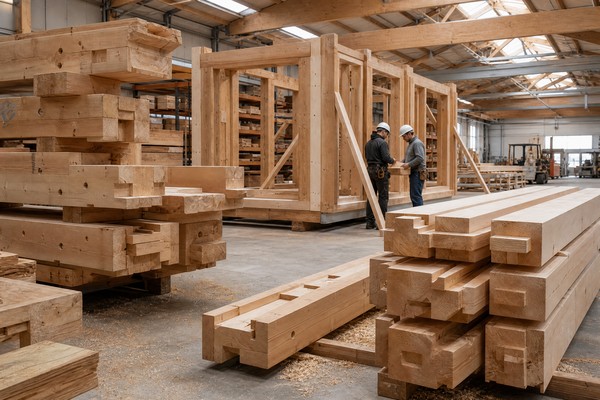
- CNC & shop precision: Evidence of CNC logs, recorded tolerances and sample components from previous projects. CNC machining reduces on-site adjustments and improves thermal performance of joints.
- Pre-assembly & factory checks: Routine pre-assembly photos/videos, test fitting of corner joints and roof segments, and signed QC checklists. Third-party inspection (pre-shipment) should be allowed and scheduled into the timeline.
- Engineering packages: Full structural calculations (loads, connections, fastener schedules), connection details, foundation loading plans and 3D models to coordinate with local engineers.
- Finish components & fenestration: Specifications for windows, doors, hardware, flashing and insulation. Confirm U-values and structural ratings if required by code or performance spec [5].
Cost breakdown and total landed cost: what should be included?
To budget accurately, build a Total Landed Cost model that aggregates all foreseeable costs from factory to finished structure on site. Below is a practical decomposition and a sample comparison table for timber species and relative cost/performance.
Essential cost components to include
- Raw material and fabrication
- Design & engineering fees (including adaptations to local codes)
- Factory QA, pre-assembly and inspection
- Packing, ISPM 15 compliance and documentation
- Ocean freight, port handling and inland transport
- Insurance and customs duties / VAT
- Local site works: foundation, crane, assembly labor and finishes
- Testing, certification and contingency allowances
| Timber Species | Typical Properties | Recommended Use | Relative Cost |
|---|---|---|---|
| Pine (Northern/Pine) | Light density, good workability, acceptable durability when treated; good thermal properties. | Economical cabins, interior elements, non-exposed facades with protective cladding. | Low |
| Spruce | Similar to pine, slightly higher stiffness; common in structural elements and rapid-drying supply chains. | Structural walls, rafters; popular in cold climates due to availability. | Low–Medium |
| Cedar | Natural decay resistance, dimensional stability, attractive grain and aroma; requires less chemical treatment. | Premium exterior cladding, exposed beams, high-end finishes where low maintenance desired. | Medium–High |
| Douglas Fir | High strength-to-weight ratio, excellent for heavy structural elements and long spans. | Main beams, trusses and load-bearing applications with visible beams. | High |
Use the table to select timber based on climatic exposure, desired maintenance interval and budget. Always ask for certified grading and treatment reports to validate actual cost-to-performance comparisons.
How should you structure the procurement process to reduce risk?
A robust procurement process protects both timeline and budget. The following stepwise approach is best practice for B2B buyers engaging a Chinese manufacturer.
- Pre-Qualification: Evaluate factories by audit reports (BSCI/SMETA if relevant), sample builds and references from similar export projects.
- Technical RFP: Issue a detailed Request for Proposal with drawings, material specs, performance criteria, delivery window and acceptance criteria.
- Design Freeze & Contract: Lock the design and list all deliverables, inspection points, payment milestones, Incoterms and penalty clauses for non-delivery or non-compliance.
- Deposit & Phase Gates: Phase payments against deliverables: design approval, pre-production samples, start of production and pre-shipment inspection.
- Factory Inspections: Book independent inspections and live video walkdowns at milestones. Require photographic evidence of packing and ISPM 15 marking before shipment.
- Shipment & Claims Preparation: Collect all export documents, container/pallet photos, and the inspection report. Buy cargo insurance and ensure claims procedures are clear in the contract.
- On-site Assembly Readiness: Coordinate crane booking, foundation works, local contractor induction, and a kickoff meeting with the manufacturer’s technical contact prior to arrival.
What supplier documentation should buyers request in a China-based manufacturing model?
OwnCabin Factory is located in Feixian Economic Development Zone, Linyi, Shandong, China. Buyers should state the proposed cabin scope and ask any supplier which project documentation is available before placing an order.
- In-house QC labs: Buyers should ask manufacturers whether they operate QC facilities with moisture meters, mechanical testing and any long-term sample monitoring, and request evidence of testing procedures.
- Trained assembly teams: Ask whether pre-assembly and trial-build SOPs are in place to minimise on-site time and to reduce fit issues; request pre-assembly records or photos where available.
- Documentation and traceability: Buyers should require batch-level timber traceability, treatment certificates and a digital project folder or equivalent documentation access for the project.
Frequently Asked Questions (FAQ)
Below are common questions from buyers procuring full log cabin kits from China.
- Q: Can manufacturers adapt designs to meet my country’s seismic and wind codes?
- A: Yes. Buyers should request load calculations and structural adaptations from their manufacturer to meet the destination country’s code requirements. Coordinate these calculations with local engineers and ensure the supplier can supply structural drawings and calculation packages suitable for local permit submissions [4].
- Q: What are typical lead times and how can I accelerate delivery?
- A: Typical lead times range from 8–16 weeks from final design approval to shipment depending on complexity and order volume. To accelerate, pre-approve standard details, select commonly stocked timber species, accept staged deliveries or choose faster sea routes where feasible.
- Q: Who handles import clearance and local transport?
- A: This depends on the Incoterm. Under FOB the buyer arranges and pays for main carriage and import clearance. Under CIF the seller pays freight and insurance to the destination port, but the buyer still handles import duties and clearance unless DDP is agreed [3]. Buyers should appoint a local customs broker familiar with timber/kit-home classifications.
- Q: Are third-party inspections allowed?
- A: Third-party pre-shipment inspections are common. Buyers should specify inspection scope and milestones in the contract and arrange for qualified agencies to attend agreed checkpoints.
- Q: What warranty and after-sales terms should a buyer confirm?
- A: Before confirming an order, request written warranty terms that specify coverage, exclusions, duration, remedies, and the claims procedure.
Procurement checklist — a concise buyer worksheet
Use this checklist as a minimum to avoid common pitfalls:
- Define the final use-case (residential, hospitality, commercial) and occupancy load.
- Specify timber species, grades and treatment; request FSC documentation if required.
- Identify local building codes and required documentation for permit submission.
- Decide on Incoterm and responsibilities for freight, insurance and import duties [3].
- Agree QC milestones, third-party inspection allowances and pre-shipment photo/video evidence.
- Set clear payment milestones tied to deliverables and inspections.
- Plan site works and on-site assembly contractor procurement early.
- Purchase transit insurance and keep a claims-ready file.
- Schedule post-delivery support and spare parts logistics.
Sample timeline (typical project)
Below is a representative timeline for a single custom cabin project once the contract is signed:
- Weeks 0–2: Design review and contract finalization.
- Weeks 3–6: Detailed drawings, engineering calculations and approvals.
- Weeks 7–10: Timber procurement, machining and component fabrication.
- Weeks 11–13: Pre-assembly checks, QC and pre-shipment inspections.
- Week 14: Packaging and export loading (allow 1–3 weeks for port bookings to align).
- Weeks 15–22+: Ocean transit (varies by route) and local customs clearance.
- Weeks 23–26: On-site delivery, assembly and finishing (dependent on local crew availability).
Recommended contract clauses and negotiation points
Protect your project by including these clauses:
- Clear deliverables list with drawings and parts schedule.
- Acceptance criteria based on measurable tolerances.
- Warranty terms specifying duration, scope, and remedy process.
- Escrow or staged payments tied to verifiable milestones.
- Inspection rights and third-party inspector appointment process.
- Force majeure definitions and realistic delay penalties.
- Data and design IP ownership—make sure you retain rights to as-built drawings.
Useful links and internal resources
For related decision support materials, see our guide on prefab vs traditional cabins and our sustainable timber sourcing guide. These resources expand on factory vs field labour trade-offs, and how to implement traceable timber procurement policies.
Talk to OwnCabin About Your Cabin Project
OwnCabin Factory is located in Feixian Economic Development Zone, Linyi, Shandong, China. For an inquiry, share your site location, intended use, floor area, climate conditions, and target delivery date so the discussion can focus on your project requirements.
Website: owncabin.com
Email: info@owncabin.com
References
The following authoritative sources support the technical and regulatory recommendations in this guide:
- [1] Forest Stewardship Council (FSC). Chain of Custody and forest certification details. https://fsc.org/en/chain-of-custody
- [2] USDA APHIS / IPPC — ISPM 15: Requirements for wood packaging material in international trade. https://www.aphis.usda.gov/plant-imports/wood-packaging-material/import
- [3] International Chamber of Commerce (ICC). Incoterms® 2020 rules and guidance on seller/buyer responsibilities. https://iccwbo.org/business-solutions/incoterms-rules/incoterms-2020/
- [4] International Code Council (ICC). International Building Code (IBC) — relevant for structural compliance and permitting. https://www.iccsafe.org/codes-tech-support/codes/2021-icc-codes/2021-ibc/
- [5] U.S. Department of Energy and ENERGY STAR program resources on building envelope and fenestration performance for energy efficiency guidance. https://www.energy.gov/ and https://www.energystar.gov/
Next steps — verified contact and strong CTA
If you are ready to procure a custom log cabin, contact OwnCabin at info@owncabin.com and provide a concise brief covering desired size, use-case, location and target budget. Use the same brief when comparing suppliers.
Contact OwnCabin:
- Email: info@owncabin.com
- Request a custom quote or schedule a technical call to review your design and timeline.
- For product information, contact OwnCabin at info@owncabin.com and specify the information needed for your project review.
Start with a short brief (desired size, use-case, location and target budget). Email info@owncabin.com.