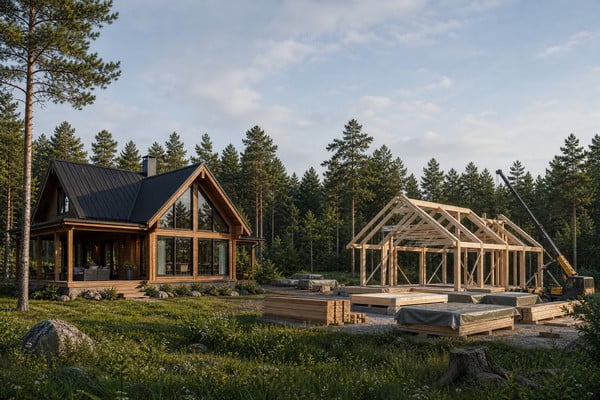
How to Choose Between Prefabricated and Traditional Log Cabins for International Buyers?
This guide is written from a buyer-first perspective and expands on how procurement, technical specifications, logistics and local approvals influence the choice between a prefabricated (prefab) log cabin and a traditional on-site build. It also includes a clear procurement checklist, a detailed technical comparison table, compliance references and FAQs to help you make an informed decision for international projects.
What are the main differences between prefabricated and traditional log cabins?
The core distinction is where and how the main building components are produced and assembled:
- Prefabricated (Prefab) : Major structural elements are manufactured in a controlled factory environment, quality-checked, packaged, and shipped as a kit for on-site assembly. Prefab offers higher repeatability, tighter tolerances, and predictable unit costs.
- Traditional On-Site Build: Logs are cut, treated and assembled primarily on the construction site using local labor and materials. This maximizes in-situ customization but introduces more variables—weather delays, variable local skillsets, longer schedules, and often greater contingency requirements.
High-level trade-offs:
- Cost predictability: Prefab > Traditional
- Schedule certainty: Prefab (factory parallel production) > Traditional (sequential on-site work)
- Ultimate design flexibility: Traditional > Prefab (although modern prefab allows extensive customization)
- Quality consistency: Prefab (factory QC and machining) > Traditional
How does international procurement affect the choice?
International procurement adds layers of complexity—shipping, customs, compliance, cross-border payments, local approvals, and the need for clear responsibilities via Incoterms. For many international buyers, the predictable costs, documented quality control and the reduced dependence on a large local specialist workforce make prefabricated cabins the preferred route. Key international considerations include:
- Shipping and packaging standards: Wooden packaging and crates must comply with ISPM 15 to prevent pest transfer during transport and customs clearance [4].
- Commercial terms and risk allocation: Define Incoterms® 2020 terms in contracts to allocate responsibilities and costs for transport, insurance and customs clearance [5].
- Local approvals and code compatibility: Even factory-built components must meet local building codes, energy performance requirements and, where applicable, log-structure guidance such as ICC 400 [6].
- Local labour and skills: Prefab kits reduce the need for highly specialised log builders on-site and permit general contractors to assemble the kit with technical support from the manufacturer.
For international projects such as glamping resorts, hospitality parcels, or multi-unit residential developments, the scalability and repeatability of prefabricated kits substantially reduce procurement friction and total project timelines.
What technical specifications should I verify before buying?
Before committing to a manufacturer, international buyers should evaluate technical specifications and third-party documentation to ensure the product matches performance expectations and regulatory requirements. The most critical technical criteria are:
Timber species, moisture content and treatment
- Choose a timber species appropriate for the destination climate (Pine, Spruce, Cedar, Douglas Fir). Each species has distinct density, thermal and decay-resistance properties.
- Confirm kiln-dried moisture content (typically stabilized to 12–18% for kit components) to limit post-assembly shrinkage and checking.
- Verify any preservative or treatment chemicals comply with destination-country health and environmental rules and are documented by the manufacturer.
Structural engineering and joinery
- Request structural calculations, load tables and engineered drawings demonstrating compliance with required snow loads, wind loads and seismic design criteria for the installation site.
- Inspect log profiles (D-log, round, square) and joinery precision (tongue-and-groove, dovetail, saddle notch). CNC precision milling and jig-assembly controls contribute to tighter seals and faster on-site fit-up.
Thermal and energy performance
- Logs provide thermal mass but may need additional insulation to meet modern R-value/U-factor requirements. Refer to recognized guidance when sizing insulation and air-sealing strategies—e.g., national energy programs and the U.S. Department of Energy guidance on insulation and air sealing [1].
- Evaluate air-sealing, chinking systems, and recommended roof insulation packages to prevent thermal bridging and moisture issues.
Windows, doors and glazing
- Confirm window and door performance (U-values, SHGC, airtightness). For high-performance fenestration, look for ENERGY STAR-rated products where applicable [2].
- Triple glazing, Low-E coatings and argon fills are common upgrades for cold or high-performance builds.
Certifications and manufacturing controls
- Ask for FSC Chain of Custody documentation if responsible timber sourcing is a priority [3].
- Review supplier quality management (ISO 9001), environmental management (ISO 14001) and any factory inspection reports or third-party quality verifications.
Buyers should request complete technical dossiers from their manufacturer, including materials lists, shop drawings, assembly sequences, connection details and maintenance guides, and ensure these documents align with project-specific engineering principles and applicable international standards to simplify local approvals and contractor workflows.
Comparison table: Prefabricated cabin kits vs traditional on-site construction
| Evaluation Factor | Prefabricated Log Cabin (Prefab kit) | Traditional On-Site Build | Estimate: Typical Cost / Time Delta |
|---|---|---|---|
| Cost Predictability | Fixed kit price + transparent shipping estimate; lower contingency needs | Material & labour volatility; higher recommended contingency (15–20%) | Prefab typically saves 8–20% on total project risk-adjusted cost |
| Production & Quality Control | Factory-controlled machining, QC checks, documentation and pre-assembly trials | Quality depends on local craftsmanship and supervision; higher variability | Prefab reduces rework risk; faster QA sign-off by weeks |
| Construction Timeline | Parallel factory production with site prep; on-site assembly weeks to months | Sequential on-site tasks; prone to weather and labour delays | Prefab can shorten build phase by 30–60% |
| Logistics & Compliance | Requires international shipping, ISPM 15 compliance, customs clearance management | Lower international shipping; may require import of specialty items | Shipping adds fixed cost; but logistics expertise reduces surprises |
| Customization & Design Flexibility | High level of customization within engineered modules; add-ons available | Full on-site customization possible; may increase cost and schedule | Traditional wins on unlimited changes; prefab wins on predictability |
Project costs and budget considerations
International buyers should build a total-cost model that goes beyond the kit price. Below are the line items to model and strategies to control each cost bucket.
Key cost components for prefabricated cabins
- Manufacturing cost: Timber, windows, doors, roof structure, components, factory labour and packaging.
- Shipping & logistics: Container freight, port charges, inland transport, insurance. Clarify Incoterm to establish responsibility [5].
- Customs duties & taxes: Import tariffs, VAT/GST, and any anti-dumping duties. Use a customs broker to estimate in advance.
- Local assembly: Foundation, minor civil works, on-site assembly labour, local installations.
- Interior finishing: Local plumbing, electrical, HVAC, finishes and furnishings.
- Permits & inspections: Building permits, environmental approvals, utility connections.
Key cost components for traditional builds
- Material sourcing: Local timber and building materials—prices may fluctuate and quality varies.
- Extended labour costs: Longer on-site labour duration and specialised skills required.
- Site works & equipment: Heavy machinery and staged deliveries.
- Project management overhead: Especially relevant for remote international buyers.
- Contingency: A higher contingency buffer (15–20%) is often prudent due to unpredictability.
Practical budget advice:
- Get a fully-burdened landed cost for prefab kits (FOB/CIF/DDP) to reveal true import and local costs [5].
- Budget for two rounds of local adjustments—one for permit-driven changes and one for site-driven adaptations.
- Arrange a local cost validation (local contractor quote) for foundations and finishing to compare against allowances.
Procurement process and buyer checklist
A clear procurement workflow minimizes surprises. Below is a pragmatic step-by-step process recommended for international projects plus a compact buyer checklist.
Step-by-step procurement process
- Initial inquiry & project brief: Provide project scope, site conditions, target finish level and required timeline.
- Concept design & budgetary quote: Manufacturer issues schematic layouts and a preliminary cost estimate.
- Design development & engineering: Produce detailed shop drawings, structural calculations and materials lists suitable for permit submission in the destination country.
- Contract & Incoterms: Agree payment schedule, lead times, warranty, and an Incoterm (FOB/CIF/DDP) to determine responsibilities [5].
- Production & QA: Factory production with in-process inspections; third-party pre-shipment inspections are recommended.
- Shipping & customs: Ensure ISPM 15 compliance for wood packaging, organize freight forwarding and customs brokerage [4].
- On-site delivery & assembly: Arrange local transport, foundation construction, and kit assembly with manufacturer technical support where required.
- Local finishing & commissioning: Complete plumbing, electrical, HVAC, insulation and final inspections for local occupancy certification.
Buyer’s procurement checklist
- Vet manufacturer experience, factory certifications (ISO 9001/14001) and references.
- Confirm timber provenance and FSC Chain of Custody if required [3].
- Obtain complete engineering packs and verify compliance with site-specific loads and codes (ICC 400 where applicable) [6].
- Clarify Incoterms and who handles customs clearance and duties [5].
- Plan for third-party inspection before shipment and an on-site technical assistance window for assembly.
- Secure local permits and utility approvals before shipment arrival to avoid demurrage or storage costs.
- Lock in a local contractor for foundations and finish works; obtain fixed-price quotes when possible.
For more context on market-level trade-offs, read our guide on prefab vs traditional cabins and consult our shipping and customs guide for detailed logistics checklists.
Frequently Asked Questions (FAQ)
Below are common questions international buyers ask when deciding between prefabricated and traditional log cabins.
- Q: Are prefabricated log cabins durable in harsh climates?
- A: Yes. When designed with appropriate species selection, moisture control, treated connections, and proper roof and foundation detailing, prefab cabins built to project-specific engineering requirements perform reliably in a wide range of climates. Ensure glazing and insulation packages are upgraded for extreme cold or heat and verify structural calculations for local snow/wind loads [1][6].
- Q: What documentation do I need to obtain local building permits?
- A: Typical permit submissions require architectural plans, structural calculations, foundation designs, energy compliance documentation (U-values/R-values), and product certifications. Buyers should obtain detailed shop drawings and engineering packs from their chosen supplier and confirm any jurisdictional variations with local authorities.
- Q: How does ISPM 15 affect shipping my cabin kit?
- A: ISPM 15 requires heat treatment or fumigation and stamping of all wooden packaging material to prevent pest transfer. Non-compliance can delay customs clearance and increase costs—so include proof of ISPM 15 treatment with your shipping documents [4].
- Q: Can I change the design after the kit goes into production?
- A: Minor cosmetic changes may be possible, but structural or dimensional changes during production incur change-order fees and schedule delays. Finalize design and permit requirements before production starts to avoid rework.
- Q: Can manufacturers provide on-site assembly supervision?
- A: Some manufacturers offer technical assistance packages: remote technical support, periodic site visits by certified assembly supervisors, or full on-site supervision depending on project scope. Ask your supplier about available support options, associated fees, and the duration of any on-site assistance.
Talk to OwnCabin About Your Cabin Project
OwnCabin Factory is located in Feixian Economic Development Zone, Linyi, Shandong, China. For an inquiry, share your site location, intended use, floor area, climate conditions, and target delivery date so the discussion can focus on your project requirements.
Website: owncabin.com
Email: info@owncabin.com
References
- U.S. Department of Energy — Guidance on insulation and air sealing for energy efficiency [Referenced for thermal performance and insulation strategy].
- ENERGY STAR — Residential windows, doors and skylights product efficiency standards [Referenced for fenestration performance].
- Forest Stewardship Council (FSC) — Chain of Custody certification [Referenced for responsible timber sourcing].
- USDA APHIS — ISPM 15 and wood packaging material import rules [Referenced for international wood packaging compliance].
- International Chamber of Commerce (ICC) — Incoterms® 2020 [Referenced for shipping contract terms and risk allocation].
- International Code Council (ICC) — ICC 400: Standard on the Design and Construction of Log Structures (2017) [Referenced for log-specific structural guidance].
What should buyers include in a first supplier inquiry?
For international procurement, buyers should seek suppliers who can demonstrate factory QA/QC, documented processes and optional responsible-sourcing credentials. Specifically, look for or request the following from potential suppliers:
- Evidence of factory QA/QC processes, and confirmation of any relevant certifications or third-party audits (e.g., ISO-aligned management systems or equivalent).
- Logistics coordination experience for ISPM 15 compliance and clear Incoterm-based shipping plans [4][5].
- Clear technical assistance options for on-site assembly and commissioning, with defined scope and fees.
For international procurement, we recommend requesting a full landed-cost quote (including recommended Incoterm) and an engineering pack early in your procurement timeline. Early alignment on foundation type, glazing packages and final finishes reduces cost and schedule risk.
Call to Action — Get a Custom Quote or Download the Lookbook
If you are ready to evaluate a prefab solution for an international project, contact OwnCabin at info@owncabin.com to submit an inquiry. A concise request should include the following information:
- A custom project quote with suggested Incoterm and a preliminary landed cost estimate.
- Sample engineering packs for permit submissions and a checklist for local approvals.
Selecting an experienced supplier and securing early engineering alignment helps minimize risk, control costs, and improve the likelihood of a timely, code-compliant delivery for international log-cabin projects.