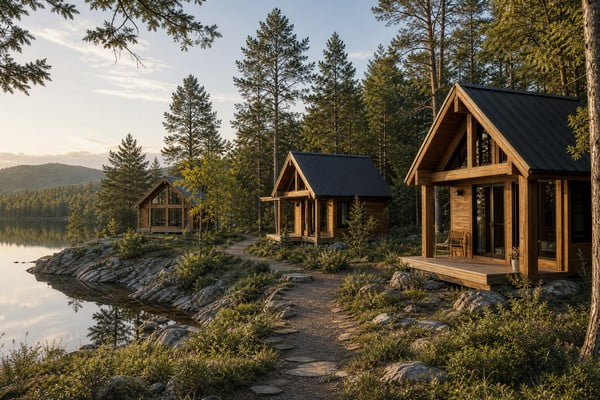
How to Successfully Procure Prefab Timber Cabins for Your Glamping Resort?
This guide consolidates industry best practices for procuring prefabricated log and timber cabins for glamping resorts, remote hospitality projects, and private retreats. It provides a practical procurement roadmap for developers, architects, and investors planning a glamping resort with prefabricated timber cabins. It covers strategic planning, manufacturer evaluation, technical criteria, regulatory compliance, cost planning, logistics, and risk mitigation to help projects deliver on schedule, within budget, and aligned with sustainability and guest-experience objectives.
What is the procurement roadmap for prefab timber cabins?
A clear, step-by-step procurement roadmap reduces risk and prevents costly delays, particularly in cross-border projects. The roadmap below is intended for international developers and investors importing complete or semi-finished timber modules, and it assumes engagement with local architects and engineers for final approvals and site works.
- Concept & Market Fit: Define the resort concept, target guest segments, occupancy plans and seasonality. Determine whether cabins will be high-season luxury, four-season insulated units, or seasonal structures.
- Site Assessment: Conduct topographic, geotechnical and utility assessments to determine foundation type, access routes for delivery, and environmental constraints. Early site analysis reduces surprises at delivery.
- Technical Brief: Produce a technical brief with cabin floor plans, thermal performance targets (U/R-values), acoustic goals, fire-safety requirements and interior fit-out standards.
- Supplier Shortlist & RFI/RFP: Issue RFIs/RFPs to shortlisted manufacturers, require test modules, factory capability statements, references and third-party inspection readiness.
- Prototype & Factory Audit: Visit the selected factory or commission a third-party audit (quality management, capacity, ISO 9001 evidence) and approve a prototype module before bulk production.
- Contracting & Incoterms: Negotiate a detailed contract with explicit deliverables, milestones, payment schedule and chosen Incoterm (e.g., FOB, CIF, DDP) to clarify cost and risk allocation [3].
- Production QA & Inspection: Implement staged inspections during production and pre-shipment final acceptance tests. Arrange independent inspections where necessary.
- Shipping & Customs Clearance: Confirm packaging meets phytosanitary rules (ISPM 15), allocate freight insurance, and engage a customs broker to expedite clearance [1].
- Local Adaptation & Permits: Local engineers adapt structural calculations and manufacturers’ drawings to meet jurisdictional building codes and permitting requirements.
- Site Delivery & Installation: Prepare foundations and utilities in parallel with production. Use manufacturer supervision for first assemblies to ensure quality handover.
- Commissioning & Handover: Complete final inspections, functional testing (HVAC, plumbing, electrics), and produce an operations and maintenance manual for the resort team.
This roadmap integrates export complexity with on-site realities and prioritizes early engagement with local technical experts and authorities to avoid rework and compliance-related delays.
How do I evaluate manufacturers and designs for glamping cabins?
Technical and commercial vetting of manufacturers is the single most important activity in procurement. For a premium glamping product you need a supplier who can combine modular efficiency with bespoke detailing and consistent export logistics.
Key evaluation dimensions
- Production Capability & Traceability: Verify factory capacity for your timeline, finished module tolerances, and chain-of-custody for timber (FSC preferred) [2].
- Quality Management: Look for ISO 9001 or equivalent quality-management evidence and documented QA/QC procedures for raw material inspection, machining, finishing and packaging [5].
- Structural Documentation: Require stamped structural calculations adaptable to your local codes and documented materials specifications for all load-bearing elements.
- Thermal & Acoustic Performance: Request U-values/R-values, air-tightness targets and test reports for glazing and insulation systems to ensure four-season performance [4].
- Fire, Moisture & Pest Protection: Confirm treatments, fire-retardant strategies and packaging compliance (ISPM 15) for international transport [1].
- Customization & Finish Options: Evaluate range of exterior finishes, joinery quality, integrated services (pre-routed conduits, pre-plumbed bathrooms) and turnkey fit-out capability.
- Logistics Experience: Select manufacturers with documented exports, port/forwarding relationships and the ability to provide DDP/CIF options if required for simplified delivery [3].
Factory visits or third-party audits are indispensable. If travel is not possible, insist on live video inspections, staged photo logs and third-party pre-shipment inspection reports.
Decision Framework: Glamping Accommodation Comparison
Choosing the right accommodation type is essential to positioning your resort and forecasting operating costs. The comparison below focuses on operational durability, guest appeal and long-term cost of ownership.
| Solution | Typical Unit CAPEX (indicative) | Performance / Thermal Rating | Ideal Use Case |
|---|---|---|---|
| Standard Prefab Timber Cabin (Panelized) | USD 25,000–45,000 | U-value walls: 0.25–0.35 W/m²K (good insulation) | Mid-tier resorts requiring rapid deployment and cost control |
| Premium Volumetric Log Cabin (Turnkey) | USD 50,000–110,000+ | U-value walls: 0.16–0.22 W/m²K (high-performance) | Four-season luxury resorts demanding Swiss-level detailing and finish |
| Canvas Safari / Tent Lodge | USD 8,000–30,000 | Limited thermal performance (seasonal use) | Seasonal, low-capex projects emphasizing nature immersion |
| Hybrid Treehouse / Elevated Cabin | USD 40,000–150,000 | Depends on structure; often high cost for site-specific design | High-unique-experience sites where view and novelty command premium rates |
Use this table as an early filter — exact costs depend on size, finish level, shipping distance, and local site complexity.
How much will the project cost and how can I optimize the budget?
Budgeting for imported prefabricated cabins goes far beyond the unit price. Below is a consolidated cost model and optimization strategies tailored for international procurement.
Typical cost categories
- Unit manufacture price: Varies by module type and finish (shell vs. turnkey).
- Pre-shipment testing & inspection: Third-party QA, prototype sign-off.
- International freight & insurance: Ocean freight, inland trucking, marine insurance — impacted by Incoterm selection [3].
- Customs duties & taxes: Import duties, VAT, local handling fees — consult a customs broker early.
- Site works: Foundations (piers, slabs), access roads, crane pads, utility trenches.
- On-site assembly & commissioning: Erection crews, crane hire, temporary storage, commissioning labor.
- Local finishes & MEP integration: If cabins are shipped as shells, account for local fit-out and service connections.
- Contingency: Recommended 10–15% for international projects.
Budget optimization strategies
- Standardize modules: Use repeatable layouts to reduce moulds, joinery variations and factory set-up time.
- Volume discounts: Early bulk commitments often translate to lower per-unit pricing.
- Offshore/onshore split: Ship fully-finished modules for remote sites where local labor costs are high, or ship shells and use local trades where competent labor exists.
- Negotiate Incoterms: A DDP or CIF delivery can simplify customs and reduce on-site logistics burden but typically increase supplier price — weigh operational benefits [3].
- Invest in performance: Higher insulation, better glazing and airtightness reduce operating costs and improve guest comfort. Energy-efficiency investments often pay back through utility savings and higher ADRs [4].
What compliance, import, and local approvals are mandatory?
Regulatory compliance is non-negotiable. Non-compliant modules can be refused at the border or rejected by local building authorities. The following are the most impactful requirements for international procurement:
- Phytosanitary and packaging: All wood packaging must comply with ISPM 15 to prevent pest transmission — this is enforced at ports worldwide and non-compliance can lead to re-export or destruction [1].
- Timber sourcing certifications: For eco-conscious markets and many operators, FSC Chain of Custody documentation is required to demonstrate responsible sourcing [2].
- Commercial terms and risk: Use Incoterms® 2020 to clearly allocate responsibilities and avoid disputes over who pays for shipping, insurance, and customs [3].
- Building code adaptation: Manufacturer drawings must be adapted and stamped by local engineers; this is essential for seismic, wind and fire-code compliance.
- Quality management certification: ISO 9001 or documented factory QA procedures increase confidence in repeatable quality and reduce change orders [5].
- Environmental permits and EIAs: Depending on the location and scope, an Environmental Impact Assessment and related permits (water, wastewater, protected areas) may be obligatory.
Because national and municipal rules vary, early consultation with local permitting authorities and hiring local legal counsel greatly reduce approval risk and timelines.
Procurement process and buyer checklist
The following checklist should be used as a working document across procurement milestones. Assign a responsible party for each item and track sign-offs.
- Project Definition: Final resort concept, target market, occupancy targets, and masterplan.
- Technical Specs: Finalized cabin schedules, U/R-values, fire and accessibility requirements, and materials list.
- Vendor Due Diligence: References, factory certificates (ISO/FSC), export history and financial stability checks.
- Contracts: Fully executed contracts with milestones, acceptance criteria, penalties for delays and dispute resolution clauses.
- Quality Plan: Staged inspections, third-party QA, and acceptance criteria for final modules.
- Logistics & Customs: Freight plans, ISPM 15 confirmation, customs broker engagement, and insurance cover notes.
- Site Readiness: Foundations, utilities, crane pads, access routes and on-site storage arranged prior to arrival.
- Installation & Training: Manufacturer supervision for initial installations and transfer of maintenance manuals to operations staff.
- Commissioning & Handover: Final acceptance, warranty activation and O&M documentation delivered.
For more on comparative procurement models see our guide on prefab vs traditional cabins and for environmental certification details consult our sustainability certifications guide.
Frequently Asked Questions (FAQ)
- Q: How does ISPM 15 affect my shipment?
- A: ISPM 15 mandates treatment and marking of wood packaging to prevent pest transfer. Your supplier must heat-treat and stamp pallets, crates and dunnage. Non-compliance can lead to quarantine holds, fines or destruction of packaging on arrival [1].
- Q: Can I require FSC-certified timber from a manufacturer?
- A: Yes. Specify FSC Chain of Custody certification in the RFP and require proof prior to contract signing. FSC certification is increasingly required for eco-tourism brands and investor ESG reporting [2].
- Q: Which Incoterm should we choose for minimal delivery surprises?
- A: There’s no one-size-fits-all. DDP (Delivered Duty Paid) transfers maximum responsibility to the seller and simplifies buyer logistics but often increases the price. FOB or CIF reduce supplier obligations and give buyers control over customs and inland logistics; discuss trade-offs with your logistics advisor [3].
- Q: Are prefabricated timber cabins suitable for four-season mountain resorts?
- A: Yes — when specified with high-performance insulation, appropriate U/R-values, airtightness, and robust glazing systems. Ask for measured thermal performance and real-world references in comparable climates [4].
- Q: What level of on-site work will always be required?
- A: Even volumetric modules require foundations, utility tie-ins, crane access and final sealing. Plan for site works in parallel with factory production to keep installation sequencing optimal.
References
- [1] USDA APHIS — Wood Packaging Material (WPM) Import Requirements (ISPM 15): https://www.aphis.usda.gov/plant-imports/wood-packaging-material/import
- [2] Forest Stewardship Council — Chain of Custody Certification: https://fsc.org/en/chain-of-custody
- [3] International Chamber of Commerce — Incoterms® 2020: https://iccwbo.org/business-solutions/incoterms-rules/incoterms-2020/
- [4] U.S. Department of Energy — Insulation Essentials (thermal performance references): https://www.energy.gov/eere/buildings/insulation-essentials
- [5] International Organization for Standardization — ISO 9001 Quality Management: https://www.iso.org/iso-9001-quality-management.html
How should developers evaluate a potential glamping-cabin supplier?
Use the checklist below to identify whether a supplier (including OwnCabin) is a good fit for your project. Buyers should verify supplier capabilities through references, sample inspections, and contractual commitments rather than relying solely on marketing claims.
What to request at the inquiry stage
Ask suppliers to confirm they can offer:
- Turnkey delivery, DDP options and partner freight forwarding for simplified import.
- FSC-compliant timber chain-of-custody, ISO-aligned factory QA and ISPM 15-compliant packing.
- On-site supervision, local partner training, and a full O&M manual to protect your asset value.
Verified Contact Information & Call to Action
Ready to advance a glamping project? Contact OwnCabin at info@owncabin.com to submit an inquiry. When evaluating any supplier, request technical specifications, applicable documentation and references that can be reviewed by investors and planning authorities. For procurement context, see the linked guides in this article.
To submit an OwnCabin inquiry, email info@owncabin.com with the project scope and target timetable. Confirm response times, deliverables and any fees with every supplier before making a commercial comparison.
Talk to OwnCabin About Your Cabin Project
OwnCabin Factory is located in Feixian Economic Development Zone, Linyi, Shandong, China. For an inquiry, share your site location, intended use, floor area, climate conditions, and target delivery date so the discussion can focus on your project requirements.
Website: owncabin.com
Email: info@owncabin.com