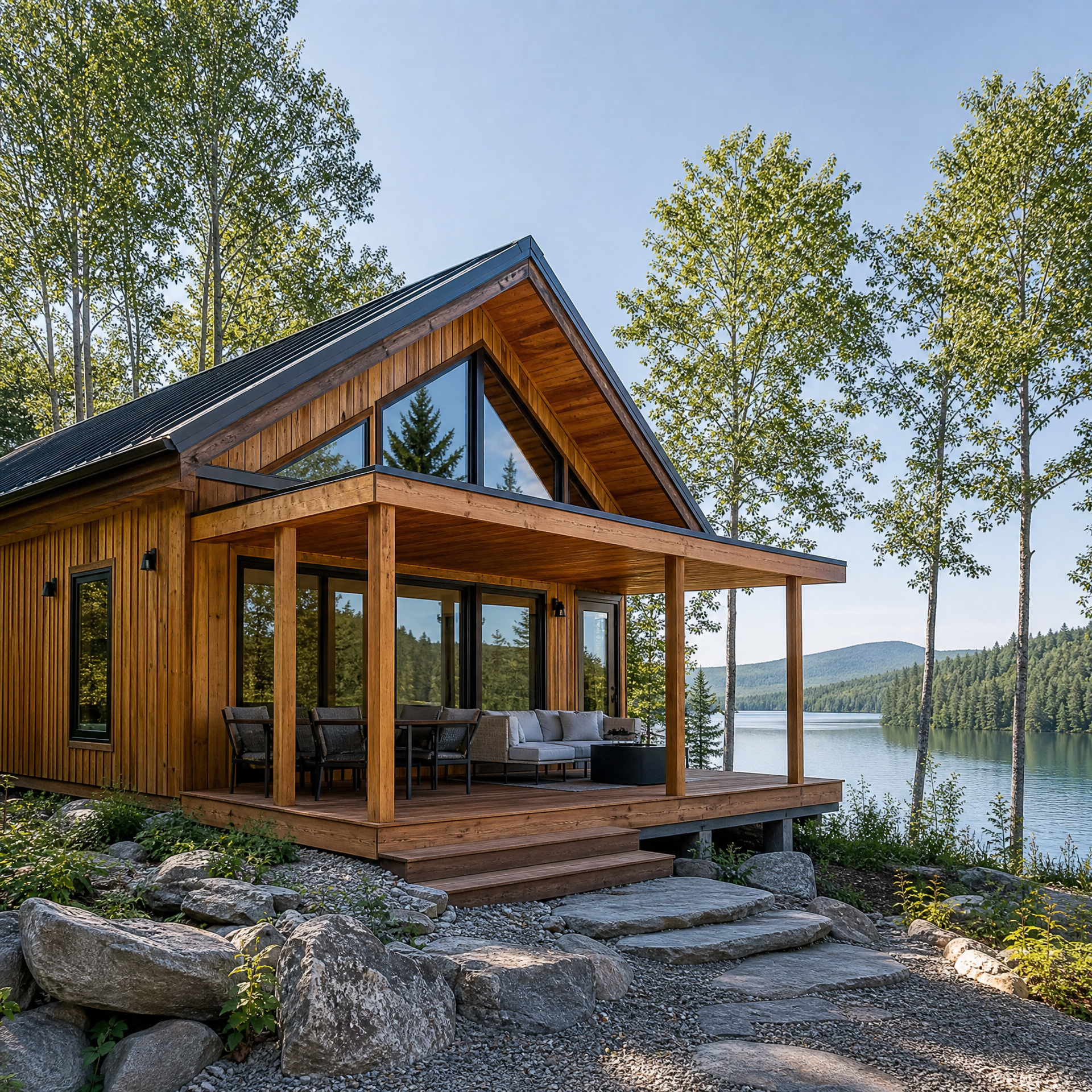
Prefab cabins and tiny homes overlap in appearance and market appeal, but they are different concepts in U.S. regulatory and industry practice. This article explains the typical meanings of each term, how various factory-built methods relate to “prefab” cabins, what “tiny home” often describes in codes and guidance, and why local law ultimately controls classification, permitting, placement, financing, appraisal, insurance, and tax treatment.
Key Takeaways
– “Prefab cabin” typically refers to a factory-built or factory-fabricated dwelling component or kit (modular, panelized, precut/log kit) assembled or installed on site; these are treated as factory-built housing under U.S. industry descriptions and must comply with applicable local building codes unless they meet HUD manufactured-home criteria. (HUD)
– “Tiny home” is a popular descriptive term for a very small dwelling; some U.S. model-code documents offer dimensional examples (for example, IRC Appendix Q), but “tiny home” is not a single universal legal classification—local jurisdictions classify and regulate them differently. (ICC Appendix Q; California HCD)
– HUD’s national Manufactured Home construction and safety standards apply only to HUD Code manufactured homes—distinct from other factory-built housing types such as modular, panelized, and precut systems. State and local rules and approvals remain central to final classification. (HUD)
– Lenders and appraisers use specific guidance for factory-built housing types (for example, Fannie Mae’s selling guide treats modular and other factory-built types differently). These are U.S. lending rules and do not guarantee financing or appraisal outcomes. (Fannie Mae)
Definitions and common usage
What is a “prefab cabin”?
In U.S. industry and regulatory terminology, “prefab” is shorthand for factory-fabricated or factory-built construction methods. The HUD information brief differentiates HUD Code manufactured homes from factory-built homes; the latter category includes multiple approaches commonly called prefab:
– Precut/log cabin kits: packages of pre-cut lumber, logs, or components shipped to site for assembly.
– Panelized cabins: factory-built standardized wall panels, roof or floor panels that are transported and joined on site.
– Modular cabins: individual volumetric modules or sections constructed in a factory and assembled on a permanent foundation on site.
HUD describes these as forms of factory-built housing that are primarily built in a factory and then assembled or installed at the site; they must comply with applicable local building codes in the installation area. (HUD Info Brief)
Note: “Prefab cabin” is an industry descriptor; final legal classification depends on how the structure is built, how it is installed, and local/state rules.
What is a “tiny home”?
“Tiny home” is a market and design term for a small dwelling emphasizing compact living. Model-code guidance exists: for example, the 2018 International Residential Code Appendix Q provides one U.S. model-code definition (a dwelling of 400 square feet or less excluding lofts, with standards for lofts and egress). However, Appendix Q is a model-code appendix and only applies where a jurisdiction adopts it. Other jurisdictions may treat tiny homes as recreational vehicles (RVs), manufactured homes, factory-built housing, or site-built dwellings based on design, foundation, and intended use. California’s HCD guidance explicitly notes that tiny homes may fall under multiple legal classifications and require approval under the applicable classification. (ICC Appendix Q; California HCD)
Types and construction methods (prefab variants)
Modular, panelized, precut/log kits — how they differ
- Modular cabins: constructed in large volumetric modules in a factory to comply with the applicable building code (commonly the International Residential Code when administered by state agencies). Modules are transported and assembled on a prepared foundation at the site. (HUD; Fannie Mae)
- Panelized cabins: built with factory-manufactured panels (walls, floors, roof sections) that are shipped and erected on site; final assembly and code compliance are confirmed at installation. (HUD)
- Precut/log kits: kits of components or milled logs shipped for on-site assembly; material and assembly quality depend on manufacturer and construction details. Technical material guidance relevant to wood systems and log construction is available from sources such as the USDA Forest Products Laboratory’s Wood Handbook; that guidance provides background on wood properties, moisture, and durability but does not replace project-specific engineering or code compliance. (USDA FPL)
Regulatory and classification differences
HUD Code manufactured homes vs. other factory-built housing
HUD’s national Manufactured Home construction and safety standards (the HUD Code) apply to homes built in a factory on a nonremovable steel frame and transported to site; such homes are regulated nationwide under HUD’s program. Factory-built homes that are not HUD Code manufactured homes—such as modular, panelized, or precut/log-kit homes—are typically required to comply with applicable state or local building codes at installation and are inspected under those codes. HUD’s Office of Manufactured Housing Programs enforces HUD Code standards, administers installation oversight and dispute resolution, and recognizes that state and local requirements still apply for installations and related activities. (HUD Office of Manufactured Housing Programs; HUD Info Brief)
Important: HUD Code rules are U.S. federal standards for manufactured homes only and should not be applied as global requirements.
Local adoption, model codes, and tiny homes
Model-code provisions such as ICC’s Appendix Q (tiny houses) provide a template for jurisdictions that wish to adopt specific small-dwelling rules. Appendix Q defines a tiny house in one way (example: 400 sq ft or less excluding lofts) and includes requirements for lofts and egress, but Appendix Q is not mandatory unless adopted by a jurisdiction. Many jurisdictions choose other regulatory pathways for tiny homes (RVs, accessory dwelling units, manufactured housing, or site-built rules). California’s HCD guidance illustrates why the label “tiny home” alone is insufficient for legal classification: the same physical product can be treated very differently depending on design, foundation, and local approvals. (ICC Appendix Q; California HCD)
Site, foundation, and installation considerations
Foundations, transport, and installation
- Modular and many panelized prefab cabins are typically installed on permanent foundations and inspected under the local code for structural, mechanical, and fire safety compliance. (HUD; Fannie Mae)
- Precut/log kits and smaller prefab cabins may be installed on a range of foundations or piers and require project-specific foundation design and inspections per local code.
- Tiny homes that are built on trailers or designed for mobility may be regulated as recreational vehicles or as HUD Code manufactured homes if they meet HUD criteria; otherwise, their classification depends on design and local law. (HUD Info Brief; California HCD)
Financing, appraisal, and insurance context
Lending and appraisal considerations
U.S. lending guidance distinguishes factory-built types: for example, Fannie Mae’s selling guide treats modular homes as housing built to applicable codes (such as IRC) and notes that prefabricated, panelized, or sectional housing must conform to applicable local building codes where installed. Fannie Mae’s guidance also notes that it does not set a single size, roof pitch, or construction-detail standard for these homes and that appraisals should use appropriate comparable sales. These are specific U.S. lending requirements and do not guarantee financing or appraisal outcomes; lenders and underwriters adopt their own policies. (Fannie Mae)
Do not assume universal financing, insurance, or appraisal treatment based only on the words “prefab” or “tiny.”
Materials and durability considerations
Wood and log construction context
Wood is a common material in prefab cabins and tiny homes. The USDA Forest Products Laboratory’s Wood Handbook provides engineering background on wood behavior, moisture, preservatives, and log-building considerations useful to architects and engineers. That handbook is technical background and does not replace project-specific engineering, manufacturing quality control, or local code requirements. Proper detailing, moisture control, and component grading are central to long-term performance of wood-based systems. (USDA FPL)
Practical comparison table
| Aspect | Prefab cabin (factory-built: modular/panelized/precut/log kit) | Tiny home (small dwelling; market/design term) |
|---|---|---|
| Typical meaning | Factory-fabricated components or modules made in a factory and assembled on site; includes modular, panelized, and precut/log kits. (HUD) | Descriptive term for a very small dwelling emphasizing compact living; legal classification varies by jurisdiction and design. (ICC Appendix Q; California HCD) |
| Regulatory framework (U.S.) | If not HUD Code manufactured home, typically subject to state/local building codes at installation (modular often built to IRC where administered). HUD Code applies only to HUD-manufactured homes built on nonremovable steel frames. (HUD; Fannie Mae) | Could be treated as RV, manufactured home, factory-built housing, accessory dwelling, or site-built house depending on local rules and how it is installed. (California HCD; ICC Appendix Q) |
| Foundation/transport | Modular: transported as modules and installed on permanent foundation; panelized and precut: assembled on site on designed foundations. | Varies: trailer-based tiny homes may be mobile (RV rules); others are installed on foundations and treated like site-built or factory-built housing depending on local classification. |
| Size example | Wide range; not limited to a specific small area. | Model-code example: ICC Appendix Q gives 400 sq ft (excluding lofts) as a template where adopted — not a universal rule. |
| Lending/appraisal notes (U.S.) | Fannie Mae distinguishes modular vs. other factory-built types and requires code compliance and appropriate comparables; does not set universal dimensional rules. (Fannie Mae) | Financing/appraisal depends on legal classification (RV, manufactured, site-built), the lender’s policies, and local market comparables. |
| Best use cases | Remote cabins, vacation homes, primary residences built to code with predictable quality control. | Downsizing, accessory units, mobile living, studio/off-grid options — regulatory outcome depends on installation and local rules. |
| Choosing between a prefab cabin and a tiny home — practical considerations | ||
| – Regulatory outcome: Start by asking your local building authority how they classify the proposed structure. The same product can receive different treatments based on foundation, intended occupancy, and local definitions. (California HCD; HUD) | ||
| – Intended permanence: If you want a permanent, code-approved dwelling on a foundation, modular or panelized prefab options are commonly designed to meet those outcomes. If you need mobility or intend to locate in RV parks, a trailer-based tiny home may follow RV rules. | ||
| – Financing and resale: Lenders and appraisers treat factory-built types differently; consult lender guidance early. Fannie Mae’s guide offers a U.S. mortgage-market perspective on modular and other factory-built housing, but each lender has its own underwriting rules. (Fannie Mae) | ||
| – Technical design and materials: For wood and log systems, follow engineered designs and standard practices for moisture control and structural connections; technical resources such as the Wood Handbook provide background but do not replace project-specific engineering and local code compliance. (USDA FPL) |
Frequently Asked Questions
Frequently Asked Questions
Q: Are prefab cabins and manufactured homes the same thing?
A: Not necessarily. HUD Code manufactured homes are a specific federally regulated category built on a nonremovable steel frame and subject to HUD’s national standards. Many prefab cabins (modular, panelized, precut/log kits) are factory-built but are not HUD Code manufactured homes and are typically required to meet applicable state or local building codes at installation. (HUD Info Brief; HUD Office)
Q: Is a “tiny home” legally defined anywhere?
A: “Tiny home” is primarily a market term. Some model-code documents (for example, ICC Appendix Q) offer a dimensional template (400 sq ft or less excluding lofts) as an example, but model codes must be adopted by a jurisdiction to apply. Many jurisdictions treat tiny homes differently based on design, foundation, and intended use. Always check local regulations. (ICC Appendix Q; California HCD)
Q: Will a prefab cabin make permitting easier than a tiny home?
A: It depends. A prefab cabin designed and constructed to applicable building codes and installed on a permanent foundation may align more directly with local permitting pathways for dwellings. A tiny home’s permitting path depends on whether it’s classified as an RV, manufactured home, factory-built housing, or a site-built dwelling under local rules. Consult local building authorities early; do not assume a specific outcome. (HUD; California HCD)
Important jurisdiction caveat
Building classification, code, permitting, placement, finance, appraisal, insurance, and tax treatment differ by country and local jurisdiction. The terms “prefab cabin” and “tiny home” are descriptive and tied to U.S. regulatory and industry concepts in the sources cited; always check current local and state regulations and consult local authorities and qualified professionals for project-specific guidance. Do not rely on this article alone for legal, permitting, or financing decisions.
Contact Us
For inquiries, please visit our website at owncabin.com or contact us via email.
References
– https://www.huduser.gov/portal/sites/default/files/pdf/Info-Brief-SingleFamilyHomeowners.pdf
– https://www.hud.gov/hud-partners/manufactured-home
– https://doh.colorado.gov/consumers-of-manufactured-homes-and-tiny-homes
– https://selling-guide.fanniemae.com/sel/b4-1.4-02/factory-built-housing-modular-prefabricated-panelized-or-sectional-housing
(Additional authoritative sources used for technical and model-code context include ICC Appendix Q and the USDA Forest Products Laboratory’s Wood Handbook; these are cited in the text where relevant. Always consult local authorities for final classification and approvals.)