What Should You Inspect Before Accepting a Timber Cabin Delivery? A Buyer’s Handover Checklist
The successful realization of a custom timber structure begins long before the first wall log is anchored or the roof trusses are hoisted into place. It commences at the staging boundary when transport carriers arrive at the property site 1. For international land owners, private residential clients, boutique resort founders, and commercial project developers, the handover and offloading phase represents a critical operational milestone. Accepting a timber cabin delivery without a rigorous, engineering-focused inspection protocol introduces structural, financial, and scheduling risks that can cascade through subsequent construction phases. Timber is a dynamic, hygroscopic natural material whose dimensional stability, surface integrity, and structural reliability depend heavily on correct handling, moisture management, and adherence to architectural blueprints during transit and initial staging 3.
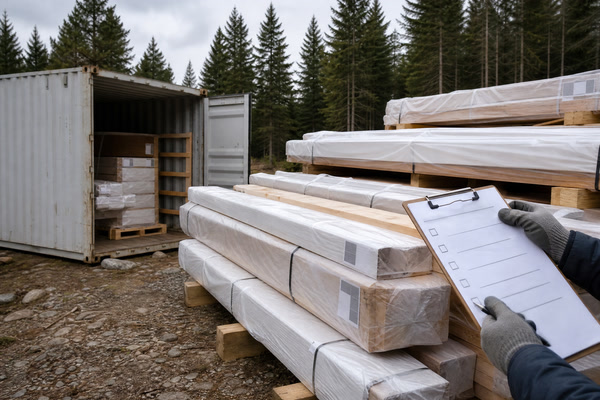
Navigating this transition requires a methodical approach that bridges factory manufacturing standards with unpredictable site-specific conditions. Whether coordinating a remote mountain retreat or a coastal development, project stakeholders must evaluate every pallet, bundle, and crated component against master packing lists, engineering drawings, and regulatory requirements. This comprehensive inspection checklist is designed to guide property owners and project managers through every dimension of the delivery handover process—from verifying fastener inventories and protective wrapping integrity to documenting transit damages and establishing secure on-site storage 8. By approaching delivery acceptance through a lens of rigorous technical oversight, buyers protect their long-term investments and ensure seamless installation readiness 2.
Why Does Timber Cabin Delivery Inspection Determine Long-Term Project Success?
The integrity of a timber building is fundamentally tied to the condition in which its structural and finishing components arrive on site. When transport vehicles discharge logs, glulam beams, wall panels, and joinery packages, the physical state of the shipment sets the baseline for all future assembly work. Any unrecorded transit damage, excessive moisture absorption during maritime or overland freight, or missing hardware can halt installation crews, inflate labor costs, and create friction with warranty providers 3. Understanding what this means for the buyer requires recognizing that offloading is not merely an administrative sign-off; it is an engineering verification gateway that safeguards structural performance across decades of environmental exposure and seasonal cycling 1.
Furthermore, timber structures interact continuously with their surrounding microclimate. If wood members are exposed to precipitation, standing water, or direct solar radiation during uncoordinated offloading, internal stresses can develop, leading to checking, warping, or fungal growth before assembly even begins 5. Establishing a structured handover protocol ensures that all parties—from logistics operators to site engineers—share accountability for component condition. It aligns site realities with design specifications, ensuring that structural tolerances required by local engineering standards are preserved from the outset 1. Every log profile, tongue-and-groove joint, and corner notch must be examined to verify that manufacturing precision has not been compromised by transit vibrations or rough cargo handling 4.
Project developers must also account for the psychological and operational momentum of the build cycle. When a delivery is accepted with hidden defects unrecorded, subsequent assembly delays disrupt contractor schedules and inflate holding costs. A disciplined handover inspection acts as an insurance policy against preventable site friction. By establishing clear acceptance criteria, buyers empower their site teams to identify anomalies immediately, ensuring that accountability rests with the freight carrier or manufacturer rather than the property owner. Comprehensive preliminary inspections mitigate downstream financial exposure and eliminate ambiguities during construction 2.
| Inspection Category | Key Assessment Parameter | Actionable Buyer Verification Step | Potential Risk if Ignored |
|---|---|---|---|
| Physical Inventory | Component count vs. bill of lading | Cross-check every bundled stack and crated item against master shipping manifests. | Missing structural elements halting erection workflows. |
| Visual Surface State | Checking, staining, and impact scars | Inspect exposed log faces and panel edges for transit-induced mechanical damage. | Unmitigated moisture ingress and aesthetic surface defects. |
| Dimensional Check | Length, thickness, and profile accuracy | Spot-check critical structural dimensions against architectural shop drawings. | Mismatched joinery and structural alignment failures. |
| Moisture Gradient | Core vs. surface moisture content | Test representative samples with calibrated resistance moisture meters. | Post-assembly warping, checking, and dimensional swelling. |
How Should You Prepare Your Site and Logistics Infrastructure Before Truck Arrival?
Site readiness is an essential prerequisite for any successful timber delivery handover. Before transport trucks navigate access roads or staging zones, the property must be evaluated for logistical feasibility. Heavy transport vehicles carrying engineered timber packages require stable, level unlading zones, adequate turning radii, and clearance from overhead utility lines 8. Failing to prepare adequate staging pads can result in aborted deliveries, demurrage charges, and unsafe offloading conditions that compromise delicate timber surfaces.
Property owners must coordinate with local civil contractors to ensure that access routes can support heavy axle loads, particularly during seasonal weather fluctuations that soften subgrades. Staging areas should be elevated slightly above surrounding grades, free of standing water, and lined with dunnage or sleepers to keep timber bundles isolated from damp soil 7. For comprehensive insights into optimizing property access and foundation staging, reviewing the prefab cabin site preparation guide provides invaluable planning frameworks. Proper site preparation transforms an erratic delivery event into a synchronized logistical operation that protects timber investments from ground-level moisture and handling hazards 3.
Logistical planning must also account for unloading equipment availability. Depending on the scale of the timber package, cranes, rough-terrain forklifts, or heavy-duty loaders may be required on site during delivery. Coordinating equipment arrival times with the trucking schedule prevents costly driver idle time and reduces the window of exposure during unlading. Site supervisors should designate clear pedestrian exclusion zones and establish communication protocols between crane operators and ground spotters to maintain an accident-free handover environment 8. Furthermore, temporary fencing and lighting should be installed if delivery schedules extend into twilight hours.
What Documents, Bill of Lading, and Packing Lists Must Be Verified First?
Before a single strap is unbuckled or a crane boom is extended, exhaustive administrative verification must take place. The delivery driver will present a bill of lading (BOL), master packing lists, customs clearance documentation for international shipments, and quality compliance certificates. Project managers must examine these documents line by line, ensuring that piece counts, package numbers, and container seals match the purchase contract and pre-dispatch manifests 2.
Discrepancies identified at this stage must be formally noted on the delivery receipt before the carrier departs. Accepting freight without noting shortages or crushed crating severely complicates subsequent insurance claims or replacement part coordination. In addition, verifying documentation ensures that specialized engineering specifications—such as those detailed in the international log cabin shipping guide—have been strictly observed throughout the transit lifecycle, protecting the project from unforeseen compliance hurdles and customs delays 8.
Administrative rigor during handover extends to tracking serial numbers and batch markers on crated joinery, windows, and doors. These identifiers link physical items to certified engineering calculations and warranty registries. If a discrepancy arises at later stages during installation, matching documentation from the initial delivery receipt ensures rapid manufacturer support without administrative ambiguity or disputed liability. Comprehensive record-keeping at this stage is a fundamental best practice for professional project administration 1.
How Do You Conduct a Rigorous Visual and Dimensional Inspection of Timber Elements?
Once administrative clearance is secured, physical inspection begins in earnest. Timber elements—whether solid handcrafted logs, precision-milled kit components, or advanced panelized wall assemblies—must be evaluated for visual soundness and dimensional fidelity 3. Inspectors should examine timber surfaces for excessive checking, resin exudation, fungal stain, or mechanical gouging caused by securing chains and forklift tines during transit.
Dimensional accuracy is equally paramount. Using calibrated measuring tools, project teams should verify that log diameters, notch depths, wall panel heights, and window rough openings match architectural blueprints within acceptable manufacturing tolerances. Minor variations in natural timber are expected, but structural deviations that affect interlocking joinery or load-bearing alignment must be flagged immediately 1. Documenting these observations with high-resolution photography establishes a clear evidentiary record for any necessary manufacturer consultations and warranty validations 2.
Furthermore, inspectors must check for twisting, bowing, or cupping in long linear members such as glulam beams and purlins. While timber naturally responds to atmospheric changes during transit, excessive distortion indicates inadequate kiln-drying or improper restraint during shipping. Identifying these defects before offloading is complete allows project teams to quarantine compromised members and request replacements before assembly schedules are disrupted. Ensuring that every structural member meets precise geometric criteria safeguards the ultimate structural integrity of the cabin 4.
What Criteria Define Acceptable Moisture Content and Protective Packaging Integrity?
Moisture is the single most influential variable affecting timber stability during delivery and storage. Wood is a hygroscopic material, meaning it absorbs and releases moisture to reach equilibrium with its surrounding atmospheric environment 3. When timber is kiln-dried or precision-crafted in controlled factory facilities and then subjected to maritime transport or humid overland travel, moisture content (MC) can fluctuate significantly. Inspectors should utilize pin-type or pinless resistance meters to test core and surface moisture levels across representative timber samples 7.
Protective packaging integrity directly governs whether transit moisture remains manageable. Shrink-wrap, weather-resistant membranes, and cardboard crating must be inspected for tears, punctures, or pooling condensation. If packaging is compromised, moisture can become trapped against timber surfaces, accelerating mold development or localized staining. Ensuring that protective packaging remains intact while allowing adequate ventilation is a delicate balance that requires careful on-site judgment 5.
Environmental exposure during transit can also introduce wind-driven rain or saltwater spray into containerized shipments. Testing moisture gradients across bundled layers ensures that trapped moisture is identified before stacking. If elevated moisture readings are recorded, immediate unpacking and air-drying protocols must be implemented to prevent permanent fungal degradation or dimensional swelling that would hinder subsequent assembly. Monitoring moisture from the outset establishes stable baseline conditions for interior finishes and structural settling 6.
| Environmental Factor | Risk Exposure Level | Recommended Mitigation Strategy | Long-Term Impact of Neglect |
|---|---|---|---|
| Precipitation & Rain | High (Fungal growth, fiber swelling) | Deploy breathable UV-resistant tarps with air gaps; avoid wrapping tightly in non-porous plastic. | Widespread fungal decay and rotting log courses. |
| Ground Moisture | High (Capillary absorption, rot) | Elevate all timber bundles at least 150mm on pressure-treated sleepers or dunnage. | Rising damp absorption and structural wicking. |
| Solar Radiation | Moderate (Surface checking, UV degradation) | Store under covered sheds or shaded temporary structures to prevent rapid drying stress. | Severe surface checking and lignin breakdown. |
| Marine Salt Spray | Variable (Coastal transit exposure) | Wash down affected hardware; inspect metal connectors for premature galvanic reaction. | Fastener corrosion and structural connection failure. |
How Are Fasteners, Hardware, and Structural Connectors Inventoried and Inspected?
A timber cabin is only as strong as the metal connectors, bolts, drift pins, timber screws, and specialized brackets that bind its organic elements together. During delivery handover, hardware packages must be inventoried with rigorous precision. Missing structural fasteners can halt assembly operations entirely, leading to costly project delays and idle labor crews. Inspectors should open hardware crates, cross-reference contents against hardware schedules, and verify that all items are accounted for 2.
Beyond quantity, quality and coating integrity must be evaluated. Exterior-grade fasteners and structural connectors require appropriate corrosion resistance—such as hot-dip galvanizing or stainless steel specifications—especially in coastal or high-humidity environments 5. Connectors showing early signs of rust, thread stripping, or dimensional non-conformance should be quarantined. Ensuring hardware compliance protects the structural load paths mandated by engineering design codes 1.
Hardware inspection also includes verifying fastener compatibility with treated wood products. Certain preservative chemicals can accelerate galvanic corrosion in dissimilar metals; therefore, fastener specifications must match engineering schedules precisely 6. Organizing fasteners into secure, weather-protected jobsite storage lockers immediately upon delivery prevents loss, theft, or weather-induced degradation during the construction phase 8.
What Protocols Govern Damage Documentation, Claims, and Carrier Liability?
Despite meticulous planning, transit incidents can occur. When timber components arrive with structural damage, crushing, or water saturation, a formal documentation protocol must be executed instantly. Project managers should not rely on verbal agreements with transport drivers; every irregularity must be photographed, measured, and recorded directly on the carrier’s delivery receipt before signing 8.
Establishing carrier liability requires prompt formal notification to logistics providers and manufacturers within contractual notification windows. Photographic evidence should capture wide-angle context shots as well as detailed macro images of damaged zones, showing package labels and serial numbers clearly. Maintaining an organized damage log ensures that replacement components can be manufactured and dispatched without disrupting the broader construction schedule 2.
When dealing with international freight, marine insurance surveyors may need to inspect damaged crates before claims can be processed. Moving or discarding damaged timber without formal surveyor sign-off can jeopardize insurance payouts. Establishing a clear internal chain of command for handling freight discrepancies ensures that legal and financial protections remain fully active throughout the claim resolution process 8.
How Do You Verify Installation Readiness and Staging Protocols on Site?
Delivery handover transitions directly into installation readiness. Once timber bundles are inspected and accepted, they must be staged on site in a sequence that mirrors the planned erection process. Staging materials haphazardly forces double-handling, increases the risk of site damage, and drains labor efficiency. Heavy bottom logs or structural base plates must be staged closest to the foundation footprint, while upper-level trusses and roof decking are placed in secondary accessible zones 7.
Furthermore, site drainage and sub-base stability must be re-verified around the staging perimeter. Puddling water near stacked timber creates localized vapor pressure that can compromise lower bundle layers. Project teams should verify that all lifting equipment, rigging gear, and temporary bracing tools are inspected and ready for deployment, ensuring an uninterrupted flow from delivery handover to structural raising 4.
Staging protocols must also incorporate security measures against theft or environmental vandalism. High-value timber joinery, custom windows, and specialized hardware crates should be stored within secure perimeter fencing or locked temporary site containers. Safeguarding staged components preserves project timelines and protects specialty materials from unauthorized tampering prior to installation 8.
What Warranties, Maintenance Guidelines, and Handover Sign-Offs Are Required?
The culmination of the delivery inspection process is the formal handover sign-off. This legal and operational milestone binds the manufacturer, shipping provider, and property owner to the documented state of the shipment. Before signing, clients must review manufacturer warranty terms, wood care guidelines, and recommended initial treatment schedules 6. Understanding warranty exclusions—such as damage resulting from improper on-site storage or unventilated tarping—is vital for long-term asset protection.
A comprehensive handover package should include maintenance manuals detailing recommended finishing products, inspection frequencies for settling joints, and guidance on environmental acclimatization. Securing these documents ensures that the timber structure receives proper stewardship throughout its operational lifespan, preserving its structural performance and aesthetic brilliance 1.
Final sign-off documents must be archived digitally and physically in project management repositories. Having immediate access to delivery inspection logs, warranty certificates, and maintenance guidelines facilitates smooth coordination with general contractors, interior finishers, and future asset managers, reinforcing the long-term value of the custom timber investment 2.
How Do Local Codes, Engineering Reviews, and Environmental Factors Shape Final Acceptance?
While factory delivery inspection verifies component manufacturing quality, final project acceptance and structural realization are governed by local regulatory frameworks. Different countries, municipalities, and regional jurisdictions enforce strict building codes that dictate structural specifications. Property owners must ensure that local qualified professionals and building authorities review foundation designs, wind loads, snow loads, seismic requirements, fire safety classifications, and energy compliance standards 1.
Additionally, utility hookups, zoning permits, and environmental setbacks must be formally coordinated with local governing bodies. Prefabricated timber structures offer immense architectural flexibility, but their ultimate safety and compliance rest upon professional local engineering oversight. Buyers should not assume that factory delivery equates to immediate zoning or structural approval; local professional verification is an indispensable final step in the development lifecycle 2.
Environmental factors such as microclimate humidity, coastal salt fog, and insect activity must also be evaluated in consultation with local builders. Tailoring protective treatments, flashing details, and ventilation strategies to regional conditions ensures that the timber cabin withstands local environmental pressures over decades of continuous habitation 4.
What Are the Immediate Next Steps for Property Owners and Developers After Handover?
With the delivery successfully inspected, documented, and safely staged, property owners and project developers must pivot immediately to execution planning. The next phase involves briefing the assembly crew, reviewing shop drawings against site conditions, and scheduling foundation anchor bolt verification. Establishing a daily site log and maintaining strict moisture monitoring protocols during the active assembly phase will safeguard the timber components as they take their permanent form 7.
For those navigating the early stages of project conception or expanding their portfolio of custom structures, exploring foundational resources such as what is a log cabin? or what is a prefab cabin? offers deeper industry context. For personalized guidance on custom timber design, material specifications, or delivery coordination tailored to your land parcel, reach out to our custom timber design team at info@owncabin.com.
The immediate post-handover window is also an ideal time to conduct a comprehensive tool and equipment audit. Ensuring that pneumatic framing nailers, heavy-duty drills, torque wrenches, and leveling instruments are fully operational prevents costly downtime once assembly commences. Coordinating crew schedules and establishing clear communication channels between site supervisors and design consultants ensures that any site questions are resolved rapidly without stalling construction momentum 2.
How Can Comprehensive Quality Control Protocols Prevent Post-Delivery Construction Delays?
Maintaining quality control throughout the delivery handover process requires an ongoing commitment from both site managers and logistics coordinators. When timber components are offloaded, every single bundle must be systematically cataloged against the master architectural breakdown. Any missing or mislabeled crating should be logged immediately into a centralized project management database. This proactive tracking prevents installation crews from discovering missing elements halfway through wall erection or roof truss placement, which can stall heavy machinery and inflate operational overhead 8.
Furthermore, continuous collaboration with local engineering consultants ensures that any minor discrepancies identified during visual inspection are addressed in compliance with local structural codes. Whether adjusting shim placements or verifying anchor bolt alignments, engineering oversight ensures that the structural integrity of the timber cabin remains uncompromised. By treating delivery handover as an integral component of the broader engineering lifecycle, property owners and developers lay a resilient foundation for long-term architectural success 1.
Quality control protocols extend to verifying the condition of subfloor plates and damp-proof courses before structural logs are laid. Even when timber components arrive in pristine condition from the manufacturing facility, laying them atop an unverified or uneven foundation pad introduces structural stresses. Professional installation teams must verify levelness and squareness before erecting the first wall course, ensuring that manufacturing precision translates accurately into completed architectural reality 2.
What Role Do Environmental Acclimatization and Post-Handover Storage Play?
Once timber elements pass initial inspection and are safely staged on site, the process of environmental acclimatization begins. Wood is hygroscopic and continuously adjusts its internal moisture equilibrium to match ambient relative humidity and temperature 3. Staged timber components should not be sealed in airtight plastic enclosures or left directly exposed to severe weather elements. Instead, breathable, UV-resistant protective covers must be suspended above bundles with adequate air gaps to permit continuous air circulation while shielding wood surfaces from direct solar radiation and torrential rainfall 5.
Project managers must also establish regular inspection routines during the pre-assembly storage window. Checking moisture meter readings at regular intervals ensures that timber components do not absorb excessive moisture from ground vapor or surrounding vegetation. If localized condensation is detected beneath protective covers, adjusting ventilation flaps or repositioning dunnage prevents mold proliferation and surface discoloration. Proper interim storage safeguards the aesthetic and structural qualities of the timber until assembly crews are ready to install each component 7.
Acclimatization duration varies depending on regional climate conditions, initial timber moisture content, and seasonal humidity swings. While factory-processed timber arrives within specified moisture parameters, site exposure requires vigilant oversight. Engaging local building professionals to determine optimal assembly timing based on local atmospheric conditions prevents post-construction shrinkage and joint separation, ensuring enduring structural stability 3.